






























AI
  • Azure AI Foundry
  • Google Vertex AI
  • Model Context Protocol
  • Agent2Agent Protocol (A2A)
  • Neo4J
  • Amazon Bedrock
Quantyca Quality Inspection
Scopri

Overview

Why data quality matters

Systemically managing data quality is essential to turn data into a valuable asset for organizations. The value of an organization’s data grows in proportion to its usage: if data is not used, it only represents risks and costs, as it must be managed, maintained, and protected.

It is difficult to expect advanced use of data if it is not of high quality and does not earn users’ trust. Conversely, when data quality is objectively measured, monitored, and transparently reported to users, it becomes easier to encourage them to leverage the available data asset for a wide range of purposes—from critical business needs to more innovative initiatives. Not surprisingly, indicators reporting data quality status are among the most important metadata presented to users in data product marketplace tools.

metadati di qualità in un data product marketplace

Metadata on data quality status is among the most important shown in a data product marketplace

The results produced by artificial intelligence applications are also better when they are based on a data asset foundation that is high-quality, reliable, and relevant to users’ needs. Generative AI, like all waves of technological innovation, is currently experiencing a period of strong enthusiasm: however, if the underlying data is unreliable, the use of agents, chatbots, and other types of assistants can provide users with responses that are often incorrect or imprecise. This risks turning the initial excitement into disappointment and creating resistance to change.

There are also other reasons to manage data quality systematically, which may be less visible but are no less important: reducing risks and costs for the organization, supporting data governance, and helping maintain compliance with international standards and industry regulations.

The desired data quality depends on the use cases

The expected level of data quality is not an absolute target but depends on the intended use of the data. In fact, a data asset is considered high-quality to the extent that it meets users’ expectations for the purpose they need it for (“fit for purpose”).

Like all data-related activities, managing data quality is not cost-free, so it should be implemented in a targeted way, always considering the balance between implementation costs and the value provided in terms of risk reduction, starting with the most critical data assets.

Risk analysis per qualità dei dati

Risk assessment is one of the main criteria for defining priorities in implementing data quality

Common problems from poor data quality

Without a systemic investment in data quality, organizations face issues such as:

Wrong decisions
When an organization’s most important data is of poor quality and is used to make strategic decisions with a significant impact on performance, it can lead to negative outcomes in terms of profit or other key business metrics.

Customer dissatisfaction
Incorrect, inconsistent, or incomplete data at customer touchpoints can cause dissatisfaction, complaints, and in some cases, the loss of customers.

Operational inefficiency
If the data assets critical to business processes are of low quality, using them to drive automation (e.g., automatically triggering a marketing campaign) is risky. Organizations often have to rely on manual process management instead, leading to delays and inefficiencies.

Governance challenges
When official organizational data assets are unreliable, shadow IT scenarios become more frequent. Different business units may develop independent data management solutions (extracting data from source systems, private dashboards, ungoverned models) that are not shared across the organization, resulting in a loss of overall governance.

To implement data quality effectively yet sustainably, it is necessary to address fundamental questions such as:
Which data assets are most critical for the organization?
For what purposes is the data being used?
What are the impacts on use cases if data quality is poor?
What is the optimal and minimum level of quality to ensure for a data asset in the identified use cases?
How can users be assured that data quality meets their expectations?
How can data quality management be implemented at scale?
How can data quality management efforts be coordinated with other initiatives outlined in the organization’s Data & AI strategy?

Challenges

A systemic approach to managing corporate data quality is built on several fundamental pillars:

Managing data quality should not be considered a one-off project with a defined start and end. Rather, it is a data management capability that requires ongoing focus and must be an integral part of all data-related projects.

Since data is a shared organizational asset managed by different professional roles, both business and IT, every stakeholder is expected to contribute to ensuring data quality within the scope of their responsibilities.

Investing in data quality improvement means prioritizing prevention—ensuring consistency in business processes during the design phase and implementing application-level controls in source systems to reduce the creation of data quality issues from the outset, rather than merely correcting them after they occur.

To resolve data quality errors sustainably, it is necessary to identify and eliminate their root causes, rather than addressing symptoms, otherwise the problem is likely to recur.

Implementing tools to support data quality management is not enough. Selected individuals must be explicitly assigned responsibility for maintaining continuous oversight of data quality in data management processes.

Solution

The intersection between semantics and data quality

Data quality management starts with the explicit definition of stakeholder expectations based on the intended use of the data, and the business rules that must be verified to ensure the data is of high quality.
These rules are defined in complement to the definition of domain concepts (e.g., “Customer”) and the attributes that characterize them (e.g., “Tax ID”), enriching the knowledge base modeled within the information architecture.
Business rules related to data quality serve as the reference for implementing quality controls within applications and data products, both preventive and corrective.

Business rules linked to the conceptual model guide data quality controls

Roles and Processes

To improve data quality, it is essential to act first from an organizational perspective, assigning explicit responsibility for quality to the roles involved in data and knowledge management processes.

I ruoli coinvolti nella gestione della qualità dei dati

The roles involved in data quality management

The main roles involved are:
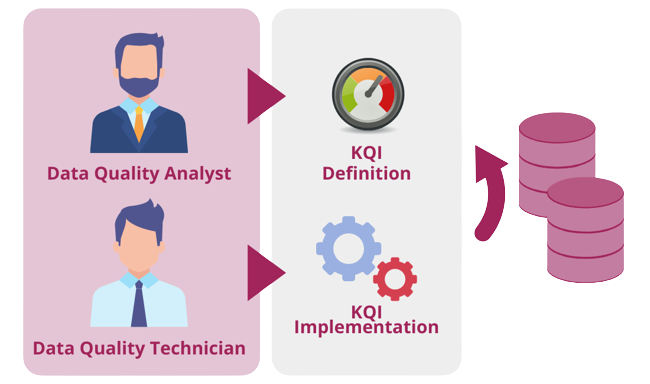
Data Owner and Data Steward: responsible for defining domain semantics and the business rules related to data quality.
Data Product Owner: responsible for the data products that expose corporate data assets for user consumption. They ensure the implementation of quality controls on the data products they manage, providing users with visibility into the data quality metrics.
Data Custodian: a member of the Data Product team or the Data Quality team, delegated by the Data Product Owner to perform operational monitoring of quality metrics on the exposed data.
Data Quality Expert: person who works within Data Governance, specializing in defining policies, standards, and best practices to ensure effective management of data quality.
Platform Engineer: person who works on the team developing shared services, including those supporting the implementation of the data quality framework, provided as part of the platform to support developers and users.

The main processes that contribute to measuring, monitoring, and reporting data quality status are:
Governance rules definition process: it defines the protocols, technologies, standards, and common rules for implementing quality controls across the organization.
Platform engineering process: it develops and deploys shared standard services (libraries, technological tools, and other software modules) to facilitate the implementation of controls, measurement, monitoring, and reporting of quality metrics.
Knowledge modeling process: it defines stakeholder expectations and the business rules that serve as the reference for verifying data quality.
Data product development process: it implements controls that allow measurement of quality metrics on the data assets exposed by the products.
Issue management process: it analyzes and removes the root causes of data quality issues that have been identified.

The execution of these processes is carried out in alignment with policies and standards defined at the Data Governance level. This aspect is crucial in modular architectures, as it ensures the interoperability of data quality controls and a consistent interpretation of the monitored metrics.

Technologies

Implementing quality controls and monitoring metrics at scale requires the support of appropriate technological tools.
Data quality metrics are runtime metadata that are part of the broader set of observability signals (which also include application and infrastructure logs, runtime resource usage metrics, and traces of user requests). For this reason, it is advisable to adopt standard observability protocols and libraries to manage the generation and transmission of these signals.
The tools required to measure, monitor, and report data quality status in a distributed architecture are as follows:

A library providing a gallery of standard, extensible data quality checks. It is often implemented as a sidecar within data products. Executing these checks generates data quality metrics.

A tool that provides the computational resources needed to run the data quality checks implemented through the chosen library.

A set of protocols and software modules to translate data quality metrics into observability signals and aggregate them within the shared enterprise platform.

Technology that enables the representation of data quality indicators based on measured metrics and visualizes their evolution over time. It also allows integration of data quality metrics with other types of metadata to be displayed in the data product marketplace.

Cruscotti

Example of data quality semaphores visualization over time

Strategy & Operating Model

To maximize the effectiveness of outcomes, it is recommended to embed data quality implementation within the context of an overall Data & AI Strategy. This allows for a harmonious management of the entire portfolio of data and AI activities and for setting priorities aligned with the value the organization aims to deliver.

Furthermore, integrating data quality activities with the rest of the strategic portfolio enables leveraging ongoing work in other programs (for example, building a platform to improve the experience for users and developers) to also support data quality objectives.

In complex organizations, operating models are usually decentralized and federated. Consequently, different working groups are involved in subsets of the activities contributing to data quality implementation. It is therefore essential to maintain both operational and strategic coordination to facilitate the synergistic work of these groups in developing quality solutions that meet user expectations.

Given the complexity of implementing data quality, especially when it is necessary to remediate a large volume of existing data solutions, it is advisable to adopt an incremental and iterative approach, focusing on prioritizing the remediation of the most critical data quality issues on the assets that pose the highest risk for their intended use.

The complete route

Quantyca supports clients through the journey required to successfully implement a data quality framework, which involves the following phases:

1. As-is assessment
High-level evaluation of the current state of data quality across data assets, selection of those most at risk, and identification of the main root causes of data quality issues.
2. Framework design
Definition of policies, standards, and tools to implement preventive and corrective actions and to measure data quality monitoring metrics.
3. Pilot implementation
Support for domain experts in defining data quality rules on a sample scope, development and deployment of platform services to support measurement, monitoring and reporting of data quality, implementation of controls on data assets and support for process and system owners in introducing preventive measures.
4. Monitoring and scaling
Support for data quality owners in monitoring results and planning subsequent iterations to further improve overall data quality.

Benefits

A structured implementation of data quality based on use cases enables organizations to:

Encourage data usage
Providing certified, consistently monitored data in a transparent way increases users’ trust in using it as a central element to guide business decisions.
Reduce organizational risk
Ensuring the quality of data assets helps mitigate the organization’s exposure to risks from wrong decisions, operational inefficiencies, and potential damage to reputation.
Improve AI outcomes
Providing high-quality data assets contributes to more effective usage of artificial intelligence to optimize key organizational processes.

Use Case

Resources

Podcast
Video
Free
21/01/2026

Quantyca Podcast: Data Quality: tra Intelligenza Artificiale ed Errori Reali

Contattaci!

This field is for validation purposes and should be left unchanged.

Entra a far parte del team Quantyca, facciamo squadra!

Siamo sempre alla ricerca di persone di talento da inserire nel team, scopri tutte le nostre posizioni aperte.

VEDI TUTTE LE POSIZIONI APERTE